
When “Allowable” Doesn’t Mean Harmless
A couple of weekends ago, I woke to the dull drone of a small engine. It wasn’t directly outside my bedroom window and it wasn’t particularly loud. It was somewhere in a neighbouring yard, close enough that the continuous mechanical hum had travelled into my bedroom and woken me.
When I got up, the motor was still running. Two hours later, when I left for the gym, it was still running. By then I was annoyed, and I remember being genuinely relieved to leave the house simply because I wouldn’t have to listen to it anymore.
A few hours later I returned home and heard exactly the same sound. The engine was still running.
By this point, I was angry.
What I found interesting afterward was how much those first two hours had already affected me. I had started my morning irritated, and that irritation seemed to follow me. I was grumpy. My tolerance for other little annoyances was lower. Something that wasn’t especially loud had somehow changed how I felt in my own home and, to some extent, how I carried myself into the rest of my day.
The machine, I eventually discovered, was a wood splitter. I contacted the city’s bylaw department and learned that, other than having started too early in the morning, this continuous mechanical drone was considered an allowable noise.
Allowable.
That word stayed with me, particularly because I have spent so much time researching how our environments influence human health and well-being.
The machine wasn’t deafening. I wasn’t concerned that it was damaging my hearing. But it had interrupted my sleep, captured my attention, changed my mood and made me relieved to leave my own home. Six hours later, it was still going.
So what exactly do we mean when we say that a noise is “acceptable”?
Hearing Damage Is Only Part of the Story
Most of us have been taught to think about noise primarily in terms of volume. We protect our hearing around machinery. We turn down our headphones. We recognize that extremely loud sounds can damage the auditory system.
But environmental noise introduces a different question.
It isn’t simply: Is this sound loud enough to damage my hearing?
It is also: What happens to the human organism when unwanted sound repeatedly interrupts sleep, captures attention or activates a stress response?
The World Health Organization describes environmental noise as an important environmental risk factor and associates excessive exposure with sleep disturbance, cardiovascular and metabolic effects, cognitive impairment, reduced performance, annoyance and changes in social behaviour. In other words, the health conversation extends well beyond the ear.¹
This is where my irritating little wood splitter becomes scientifically interesting.
Why Couldn’t I Just Ignore It?
Sound is information. Our auditory system continually monitors the environment because, from an evolutionary perspective, sound can tell us something important about what is happening around us.
A sudden noise during the night demonstrates this beautifully. Your brain doesn’t wait for your conscious mind to determine whether the sound came from the furnace, a door closing or something outside before responding. Sound can capture attention and trigger physiological responses before we have consciously decided whether it matters.
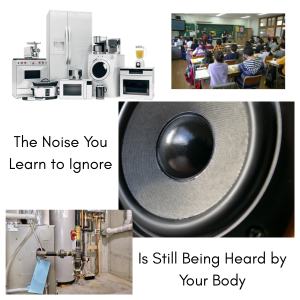
That system was enormously useful when an unexplained sound could indicate an approaching animal or another immediate threat. The problem is that the same biology now exists in environments filled with traffic, HVAC equipment, generators, aircraft, machinery and countless other mechanical sounds.
WHO’s review of the biological mechanisms associated with environmental noise specifically examines pathways involving the stress response and cardiovascular and metabolic effects. The research recognizes that perceptual and psychological factors can modify how noise affects us.²
Put more simply, the sound enters through the auditory system, but the response doesn’t necessarily end there.
When the brain interprets unwanted noise as disturbing, threatening or requiring attention, stress-response systems can become involved. Repeated activation of those systems—and the sleep disruption that environmental noise can cause—is one of the mechanisms researchers have investigated when examining the longer-term relationship between noise exposure and cardiovascular and metabolic health.
That does not mean being angry at a neighbour’s wood splitter for one morning causes cardiovascular disease. That would be an enormous—and scientifically irresponsible—leap.
What it does illustrate is something far more useful: a sound does not have to injure your ears to affect you.
“Annoyance” Isn’t as Trivial as It Sounds
This was probably the part of the WHO research that surprised me most.
In everyday conversation, calling something annoying almost minimizes it. Annoyance sounds like an inconvenience: somebody’s dog barking, a leaf blower at 7 a.m., construction down the street or, apparently, a wood splitter running for most of the day.
But environmental-health researchers actually measure noise annoyance.
In 2024, WHO published updated disability weights for health states associated with environmental noise. The work included separate weights for moderate and severe annoyance as well as sleep disturbance. These disability weights are tools used in population-health research to quantify reductions in health when calculating disease burden.³
That doesn’t mean every irritating sound constitutes a disease. Rather, it recognizes that persistent environmental annoyance and sleep disturbance can meaningfully affect well-being across populations.
That distinction made my own experience more interesting to me. Within only a couple of hours, I could recognize that the sound had altered how I felt. I hadn’t developed a medical condition. I was simply more irritable, less tolerant and increasingly desperate for the sound to stop.
Now imagine that exposure isn’t six hours on a Saturday.
Imagine it is part of your environment every day.
Sleep Changes the Conversation Again
There was another part of my experience that matters: the noise woke me up.
The auditory system does not simply switch off when we sleep. It can’t. We still need the ability to detect potentially meaningful sounds in our environment, which means noise can disturb sleep even when we aren’t consciously lying there thinking about it.
WHO has treated nighttime environmental noise as a distinct public-health issue for years. Its Night Noise Guidelines for Europe established a health-based target of 40 dB Lnight,outside—the annual average nighttime sound level measured outside—to protect the public, including vulnerable groups. WHO’s community-noise guidance has also recommended less than 30 dB(A) inside bedrooms at night for good-quality sleep.⁴
These numbers aren’t hearing-damage thresholds. They are dramatically lower.
And that is precisely the point.
When we talk about environmental noise and health, we are not simply asking whether a sound is loud enough to injure the ear. We are asking whether the acoustic environment allows the human body to sleep, recover, concentrate and function without unnecessary interference.
Sleep disturbance matters because sleep itself matters. It supports memory and learning, emotional regulation, metabolic processes, immune function and cardiovascular recovery. Repeated interference with sleep therefore has consequences that extend well beyond feeling tired the following morning.
One Million Healthy Years
Perhaps the WHO statistic that puts the scale of this issue into perspective better than anything else comes from its landmark assessment of environmental noise in Europe.
WHO estimated that at least one million healthy life-years were being lost every year from traffic-related environmental noise in western Europe alone. The assessment considered cardiovascular disease, cognitive impairment, sleep disturbance, tinnitus and annoyance.⁵
Read that distinction carefully.
Not one million complaints.
Not one million irritated people.
One million healthy years of human life.
WHO calculated this using disability-adjusted life years, or DALYs, a public-health measure used to represent years of healthy life lost through illness, disability or premature death.
And the science has continued to evolve. WHO now estimates that approximately one in five people in the European Union—around 100 million people—are exposed to unhealthy levels of road-traffic noise, with hundreds of thousands of healthy life-years lost annually from road, rail and aircraft noise.⁶
Environmental noise is not merely an inconvenience. It is a legitimate public-health issue.
Now Let’s Talk About Data Centres
This brings me back to a subject I recently explored on my Renovation Secrets podcast: the extraordinary expansion of data centres required to support our increasingly digital world and, particularly, the rapid growth of artificial intelligence.
Data centres require substantial mechanical and electrical infrastructure. Cooling equipment, fans, pumps, transformers, generators and other systems can create an acoustic environment very different from the occasional lawn mower or Saturday afternoon wood splitter.
And unlike my neighbour’s machine, data centres don’t finish splitting the pile of wood and shut down.
Their infrastructure operates continuously.
This is where we need to be extremely careful with the science. The WHO environmental-noise guidelines were not developed specifically around hyperscale AI data centres. Much of the strongest evidence concerns transportation noise, with WHO’s 2018 guidelines also considering sources such as wind turbines and leisure noise. We cannot simply take every health outcome associated with decades of traffic-noise research and declare that it applies identically to people living beside data centres.
But we can—and should—use what that research has taught us to ask much better questions.
What sound levels reach neighbouring properties, particularly at night? What are the frequency characteristics of that sound? Is it tonal or continuous? What happens inside nearby bedrooms? How does exposure change with weather and operating load? How long are people exposed? And are the standards being used to approve these facilities designed simply to establish whether a noise is legally permissible, or whether the resulting acoustic environment actually protects human health?
That last question brings me straight back to my backyard.
“Allowable” and “Healthy” Are Not Synonyms
Noise bylaws serve an important purpose. Communities need objective standards to determine what constitutes an unreasonable disturbance, and no regulatory system could possibly guarantee complete silence.
But regulatory compliance answers a regulatory question.
Human biology asks a different one.
My wood-splitter experience was temporary. Eventually the machine stopped and the quiet returned. But those few hours gave me a surprisingly tangible example of how something in our physical environment can influence sleep, attention, emotion and behaviour without ever reaching a level we would ordinarily describe as dangerous.
That is why the conversation around data centres—and environmental noise more broadly—cannot begin and end with whether a facility meets an allowable decibel limit.
We need to understand duration. Timing. Frequency. Tonality. Repetition. Nighttime exposure. Sleep disturbance. The characteristics of the surrounding community. And what happens when an environmental exposure continues not for six hours, but for years.
This isn’t an argument against technology. I use technology, including AI, extensively in my own work. The enormous benefits these technologies may provide are precisely why we should be willing to have a serious conversation about how the infrastructure supporting them is designed.
Progress and human health should not have to be opposing objectives.
Perhaps the bigger lesson is one we have encountered repeatedly throughout the built environment: what we don’t consciously notice can still influence us.
Light affects our circadian system whether or not we understand melanopic response. Indoor pollutants enter our lungs whether or not we can smell them. Our brains continuously interpret visual and sensory information we never consciously examine.
Sound belongs in that conversation too.
The environments we create never stop interacting with human biology simply because we’ve decided their effects are “allowable.”
And maybe that is the question we should be asking before we build the next generation of infrastructure:
Not simply, “Are we allowed to do this?” but “What will it be like for a human being to live beside it?”
Sources
- World Health Organization Regional Office for Europe, Environmental Noise Guidelines for the European Region.
- WHO, Biological Mechanisms Related to Cardiovascular and Metabolic Effects by Environmental Noise.
- WHO Regional Office for Europe, Disability Weights for Noise-Related Health States in the WHO European Region, 2024.
- WHO, Night Noise Guidelines for Europe and WHO guidance on community noise.
- WHO, Burden of Disease from Environmental Noise: Quantification of Healthy Life Years Lost in Europe.
- WHO Regional Office for Europe, current environmental-noise health guidance.